
North American Crop Update
- Monday May 27 2008
This analysis featured in the May 27, 2008 issue of the HGCA's MI Prospects, Volume 10, Issue 24
Key Points
A late spring in North America means that crop prospects are less certain at this time than they normally are. For the US, the swing back into soyabeans from maize may be larger than suggested in the prospective plantings survey. On the Canadian prairies while not yet critical anywhere, moisture levels are below averages in most areas.
US
Winter Wheat - The 2008 winter wheat crop was not planted in the best of conditions last fall, with poor moisture over much of the south western Great Plains continuing to be a concern prior to crop dormancy (Graph 1). However, moisture conditions appear to have been relieved somewhat this spring. Although crop conditions have not improved significantly, they have not deteriorated as they typically do in late spring and early summer. Thus, the crop looks in slightly below average condition in mid-May and is on average about a week late heading.
Given favourable price last autumn, the planted wheat area has increased although this may have been restricted to some degree by the dry conditions. If moisture condition had been more favourable, an area larger than 1Mha might have been withdrawn from Conservation Reserve Programs. Most of the increase in wheat area was in the soft red winter wheat states east of the Mississippi, where there is more flexibility in crop rotations and planting conditions were more favourable.
The early May USDA survey estimated the crop at 48.4Mt, 17% above ‘07 with harvested area up 7% and yield up 5%. A crop of this size would be the largest since 1998, which also followed favourable prices and came off a relative large harvested area. Much of this year's increase is expected to be soft red winter wheat.
Spring Wheats - The USDA's Prospective March Planting survey suggested that farmers planned to increase durum area by 22% to 1.06Mha which represents a recovery from the small areas of the last two years (Table 1). Plans for other spring wheat plantings were up 8% from ’07, at 5.80Mha. These areas are not large in an historical context despite the very high prices at the time of the survey. It would seem that with the development of more moisture tolerant varieties maize and soyabeans, production has extended into traditional wheat areas in the Upper Mid-West.
continue
Similar to last year planting was initially slow to get underway but has speeded up and completion will be ahead of normal. Emergence of the crop is about a week behind average.
Maize - The USDA's prospective March planting survey suggested farmers planned to cut back on last year's maize area, the largest since 1944, by 8% to 34.8Mha. This would still be the second largest area in recent times. Field conditions have been relative wet and cool and this has been attributed to sowing delays(Graph 1). However, as with wheat the rapid adoption of conservation tillage practices may also have been a factor. As of 18 May, 73% of the crop had been planted with 46% going in the previous two weeks. Planting progress is, however, still a week behind last year's progress which was in turn a week behind the five-year average. Crop emergence as of 18 May was at 26%, also lagging last year’s 59%, and the 5-year average of 56%. There are two implications for late planting. After a certain date late sowing implies an implicit yield penalty. Hence, farmers will tend to switch to shorter season soyabeans.
continue
Soyabeans - The USDA's prospective March planting report suggests soyabean area will be 30.3Mha, 18% above ‘07 and about equal to that of ‘06. As of 18 May, 27% of the crop was in the ground compared with 52% last year and a 5-year average of 47%.
Actual planting of soyabeans occurs from six to ten weeks after the USDA undertook this survey. And farmers do make changes to their plans, depending on their situation. The most significant uncertainty for US farmers last year was the availability of nitrogenous fertilizer for the much higher maize area. In all instances the prospective plantings survey underestimated eventual changes in areas.
This year the lateness of the season is creating uncertainty. In the past relative price prospects have also been an indicator, but this year price prospects for both maize and soyabeans are unprecedented, as also, of course, are costs. What is evident is that the combined area of maize and soyabeans will be a record and cotton planting continues to decline in favour of these related grains.
Canada
Cropping patterns on the Canadian prairies have over the years become increasingly diverse as farmers have sought alternatives to the once almost ubiquitous hard red spring wheat. While wheat is still the largest crop in terms of area, harvested area is half of what it was 25 years ago and much of what is grown is not the traditional hard red spring wheat. This trend has, of course, been driven by market prospects.
Given the very favourable wheat prospects, potential existed for a very substantial shift back into wheat and away from new crops such as canola and field peas. The Statistics Canada sowing intentions survey indicates that this will not occur. Canola and dry pea sowings will be up again and increases in spring wheat and durum areas are relatively modest (Table 2). Much of the substantial increase in winter wheat plantings is in eastern Canada.
continue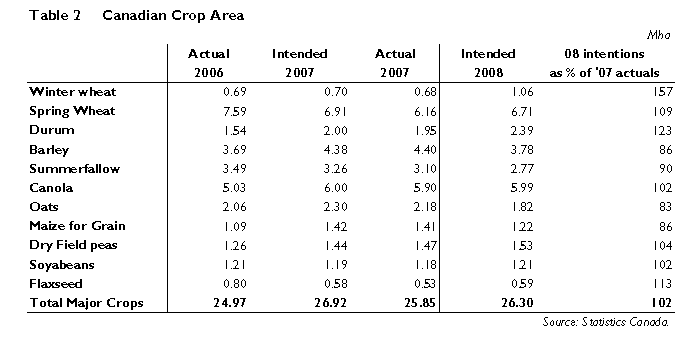
The indications are that the barley and oats areas will decline. The scenario here is that livestock on the Prairies are increasingly dependent on imported US maize. And this will continue while a sufficient proportion of the Prairie crop meets oat milling and malting quality requirements.
As in the US, it has been a late season on the Prairies. The Canadian Wheat Board reported on 15 May that sowing progress was slow due to cooler than normal temperatures. Moisture conditions, while not yet critical anywhere, are below average over large areas of the Prairies.
In eastern Canada, as is often the case, sowing intentions indicate that maize and soyabean area trends will mirror those south of the border. Plantings intentions for maize are down 13% and those for soyabeans are up 3%. There was a very large increase in winter wheat area sowing in autumn last year.
David Walker 001 780 434 7615
top of page